


The food industry has a great risk of explosion because they work with raw materials of plant origin. These materials, such as flour, starches, cakes, etc.; They generate clouds of dust where they are contained, whether for processing, packaging or transportation. The equipment where dust explosions can occur are silos, hoppers, bag filters and cyclones.
A DUST EXPLOSION is defined as a combustion of a cloud of dust that propagates itself, and develops quickly enough, so that the gases and steam, product of this combustion, generate in a sufficiently confined environment, a pressure rise high enough and at a speed fast enough to cause the confinement to break and generate the effects of an explosion.
Explosion pentagon
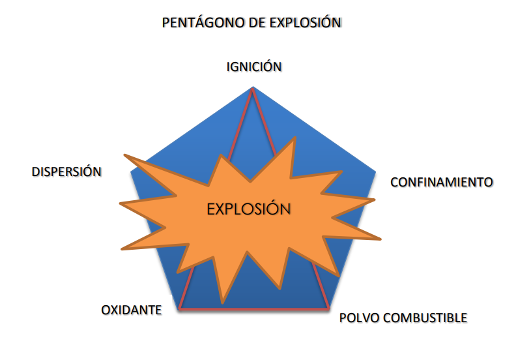
Ignition sources, based on their origin, can be classified as: a) Of chemical origin, motivated by some chemical reaction (decomposition, polymerization, self-heating, etc.) b) Of thermal origin, contact with hot elements or surfaces. c) Of mechanical origin, caused by friction, shock or fracture of hard materials, with the possibility of presence in mechanical equipment. d) Of electrical origin, caused by sparks or electric arcs, both by active conductors and by possible accumulations of static electricity or by local heating that exceeds the ignition temperature of the dust.
What is an explosive or combustible dust?
There are several definitions but they all agree that it is a very small particulate that, when dispersed in the air, has the ability to catch fire under certain conditions. NFPA654 (Ed. 2006) defines combustible dust as a solid particulate that presents a risk of fire or explosion, regardless of size or shape, when suspended in air (or other oxidizing medium) at various concentrations.
It is considered particulate matter:
- Powder.
- Fibers.
- Fragments.
- Flakes.
- Husks (flakes).
- Mixture of any of the above.
The particle size of common materials (microns):
- Salt: 100.
- White sugar: 450-600.
- Talc: 10.
- Spores: 10-30.
- Flour: 1-100.
Foods that apply as combustible dusts
Garlic, alfalfa, cotton, rice starch, corn starch, wheat starch, sugar, cocoa powder, coffee, coconut shell, lemon peel, onion powder, spice powder, potato starch, sunflower, gluten, xanthan gum, rice flour, oat flour, flour peanuts, rye flour, corn flour, potato flour, wheat flour, lemon, malt, apple, peach, tobacco mix, potato, parsley, rice powder, wheat grain powder, walnut powder, soybean powder, beet, flax seed, cassava seed, sunflower seed, semolina, tomato and carrot.
What should we know about the powders we work with?
The dusts that are used as raw materials in an industry must be characterized, that is, analyzed and verified whether or not they are combustible and therefore explosive. To begin dust analysis, it is important to consult NFPA standards 68, 69 and 654; In these documents you can consult everything necessary to understand the risk generated by combustible dusts in the Industry.
In a characterization of a powder, the following information can be obtained: Particle size, dust concentration, minimum ignition energy, explosive limits, deflagration index Kṣt, explosive index Pmax. In the NFPA standards, theoretical values of Kst and Pmax can be obtained, which is the minimum information required to locate each dust vs. risk.


Illustration 1. Graph of the behavior of a combustible dust explosion
How to deal with risk when working with combustible dusts?
- Prevention: Mechanical or pneumatic cleaning, information for staff, training, etc.
- Mitigation: Apply some of the existing solutions on the market. Fike offers Venting and Insulation.
- Suppression: Elimination of risk; Fike offers systems with electronic sensors that activate fire suppression agents that control the fire and eliminate the explosion.
- Containment: Set up equipment capable of containing the explosion, for example confining the equipment in a bunker. This method is expensive and unfeasible in the food industry.

Illustration 2. Vent panels
Passive mitigation with Fike
Fike is a specialist in solutions that mitigate the risk of explosion. The first option is venting, which consists of calculating a minimum venting area for equipment at risk. This area is replaced in the equipment with vent panels or vents, which act as a fuse and in the event of a sudden rise in pressure, they break and allow the fireball that is created in an explosion to dislodge the equipment. This solution protects the equipment and prevents it from being destroyed and affecting people and/or neighboring equipment. The vent panels are easy to assemble and do not require any subsequent maintenance, only a visual inspection.

Illustration 3. Flame arrester
When the equipment is in a place in the plant where people circulate, Fike suggests the installation of additional equipment called a flame arrester. This is responsible for circulating the fireball, which is generated in the explosion by a labyrinth system responsible for converting the fireball into simply hot air; This means that if a person passes by at the exact moment of the explosion, they will only receive the effect of hot air and not a fireball.
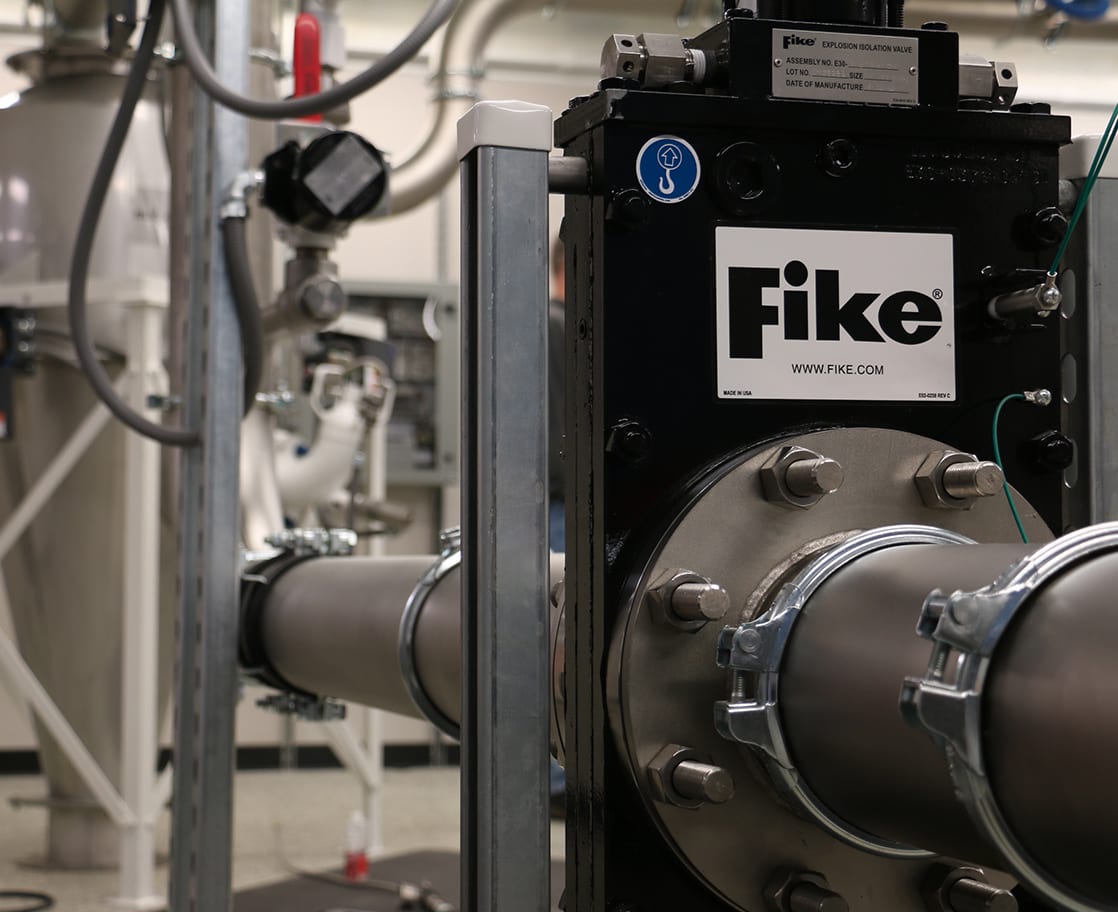
Illustration 4. Isolation valve
In case you have equipment interconnected by ducts and handling combustible dusts, Fike also offers an insulation solution. It must be taken into account that venting does not extinguish the fire and it travels upstream feeding with air saturated with dust; For this reason, the use of a ValvEx valve due to its construction makes a quick closure, preventing the passage of the fire to other parts of the plant.
Flexilatina de Colombia, as Fike’s technical and commercial representative, is at your disposal to design this type of mitigation and provide the necessary solutions.
