


According to ASME VIII Div. 1, every hermetic container that works at a pressure higher than atmospheric pressure must have a pressure relief device (PRD Pressure Relief Device), either a relief valve or a rupture disc.
The objective of a PRD (Pressure Relief Device) in processing plants is to avoid damage to equipment, avoid injuries to personnel or eliminate any risk that compromises the well-being of the community in general. A PRD does not have the function of controlling and/or regulating the pressure in a container.
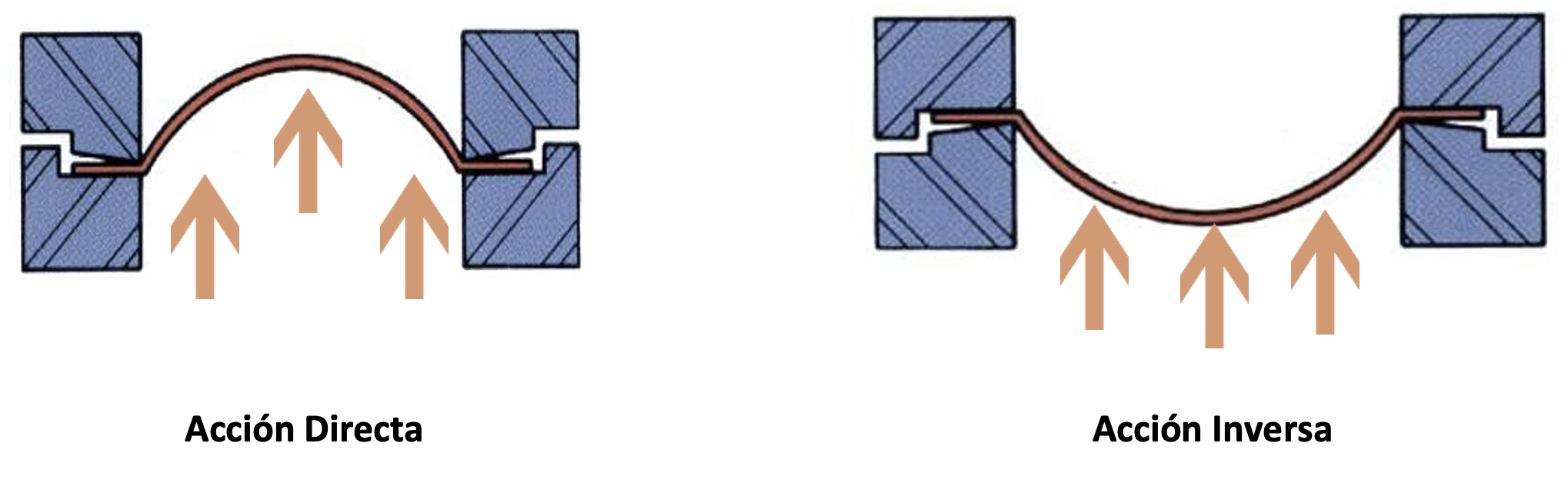
Rupture discs are one of the safest and most used solutions for pressure relief, they can work with liquid, gas and/or steam media. Currently there are two types of rupture discs, forward or direct action and reverse or reverse action, the latter being the most used and safest. When we talk about these types of action, we refer to their geometry. Rupture discs are dome-shaped, that is, they are concave; When they are direct acting, the pressure of the container to be protected acts on the concave part and when they are reverse acting, the pressure acts on the convex part. They are also classified by their form of rupture, there are fragmentable and non-fragmentable ones; The latter being the safest since when they break they do not disintegrate and only open, releasing and relieving the internal pressure of the container.
Fike has been manufacturing rupture discs for more than 50 years. It has a wide variety of materials, the most common being 316L stainless steel, but it also uses any special alloy such as Titanium, Monel, Hastelloy or Inconel. Within its solutions portfolio there is also graphite, an application that is also very common. Carbon steel is not an ideal material for manufacturing rupture discs due to its high carbon content, which does not allow correct deformation.


Holders Fike
It is important to know the meaning of the following terminology:
- Burst pressure: It is analogous to the set pressure of a relief valve; It is the pressure at which the disc will break at a certain temperature. Fike is an ASME accredited manufacturer, this requires that, to manufacture a disc, it must test at least 3. The result of the pressures at which the discs broke will be the pressure marked on the final disc.
- Manufacturing range: It is a tolerance that is agreed between the client and the manufacturer; This cannot violate the true tolerance that is given by ASME VIII, Div. 1.
- Tolerance: This is what the standard requires, according to ASME, the tolerance allowed for burst pressures ≤ 40 PSI, the tolerance must be ± 2 PSI; for burst pressures > of 40 PSI, the tolerance must be ± 5%
- Operating radius: It is a quotient that relates the maximum operating pressure, divided by the burst pressure marked on the disc. This value is expressed in % and can vary between 50% and 95%, with 95% being a value that shows the manufacturing quality of the disc.
The diameter of the disc and the burst pressure must always be defined by process specialists. There are three mathematical methods to determine the sizing of rupture discs, these are:
- Kd discharge coefficient method.
- Kr. flow resistance method
- Combined capacity method.