

Metal expansion joints are flexible fittings that are mounted in pipes to absorb movements caused by thermal expansion and/or mechanical vibration.
Thermal expansion generates movements in different directions in a piping system, which led to the development of different joints to absorb these movements or some combination of them.
The flexible element of the joints is the bellows, which is normally manufactured in austenitic stainless steels AISI 304, 304L, 316, 316L, 316Ti, 321, 347; or in special alloys such as Inconel®, Incoloy®, Monel® or Hastelloy®.
Most common metal expansion joints
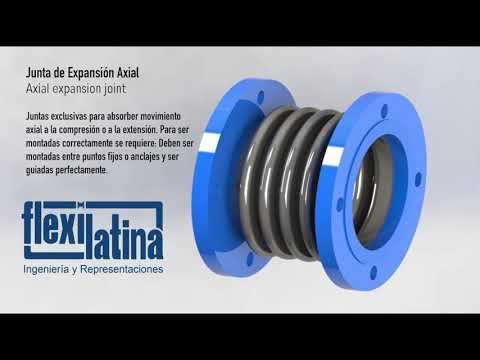
- Axial expansion joint
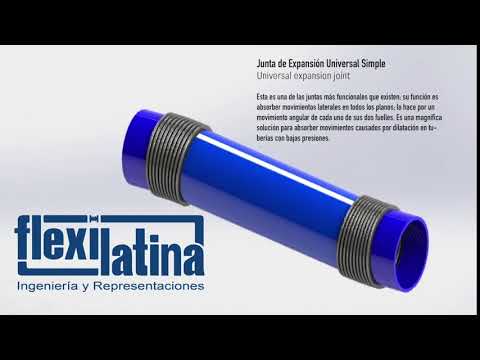
- Universal or Swing expansion joint
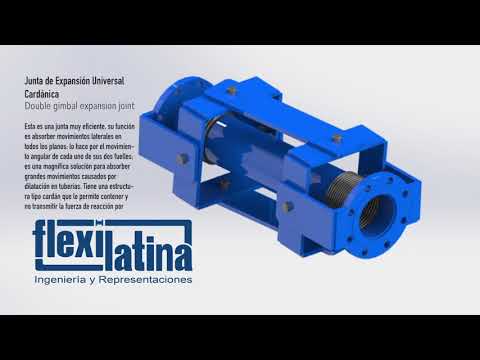
- Universal Cardanic (Double gimbal expansion joint)
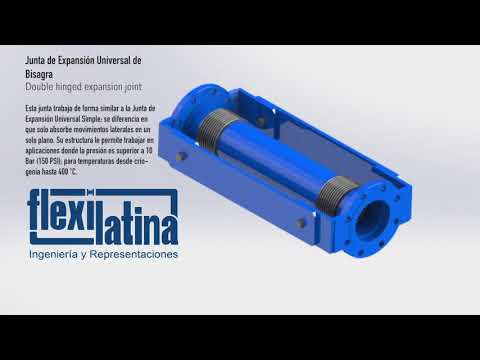
- Universal hinge (Double hinged expansion joint)
- Simple Cardanic (Gimbal expansion joint)
- Simple Hinge (Hinged expansion joint)
- Universal self-compensated with bypass (Pressure balanced universal expansion joint)
- Axial anti-squirm (Axial expansion joint anti-squirm )
We manufacture in diameters from 1 ½″ to 160″, following the manufacturing and quality criteria of EJMA and ASME Section VIII division 1 and 2.
We develop the manufacture of square, rectangular, hexagonal or octagonal expansion joints, to be used in hot gas or condensate ducts.
The most common operating temperature range of the joints is from -200ºC to 750ºC, and they are manufactured for pressures from vacuum to 600 psi.
The metallic expansion joints, manufactured by Flexilatina of Colombia, have the endorsement of our partner Dinatecnica of Brazil.
All manufacturing and quality criteria of EJMA (Expansion Joint Manufacturers Association), ASME Sec. VIII division 1 and 2 and DIN (Deutsches Institut für Normung), as a result, are applied in our manufacturing and assembly processes.
Flexilatina de Colombia has a complete team of engineers that accompany the user during the whole process of selection, calculation, assembly and inspection of the metallic expansion joint(s).
As a result, we have characteristics that make our firm has provided flexible solutions in all types of industries in Colombia, Venezuela, Ecuador and some Central American countries.
Metal expansion joints


Technical Specifications
Ficha técnica JEUS F
Ficha técnica MEJ-SQ F
Ficha técnica JEA-AP F
Ficha técnica JEA F-JEAT F
Ficha técnica JEUB F
Ficha técnica JEUC F
Ficha técnica JEC F