


Customer issue
The customer contacted Flexilatina because he had several burned fabric joints in the hot air line, which were leaking. They needed a diagnosis and wanted a solution to replace the installed gaskets with a flexible one that had greater resistance to the operating conditions they were handling. The first joints installed had not been manufactured by Flexilatina, the client contacted us because of our experience in manufacturing flexible solutions for the industry.
Diagnosis
The fabric expansion joints did not have insulation to protect the fabric from temperature spikes generated by failures of the installed dampers. On the occasions when the boiler was turned off, the air was returned with traces of hot sand and came into direct contact with the fabric, generating cracks and leaks to the outside of the flexible element.
Solution:
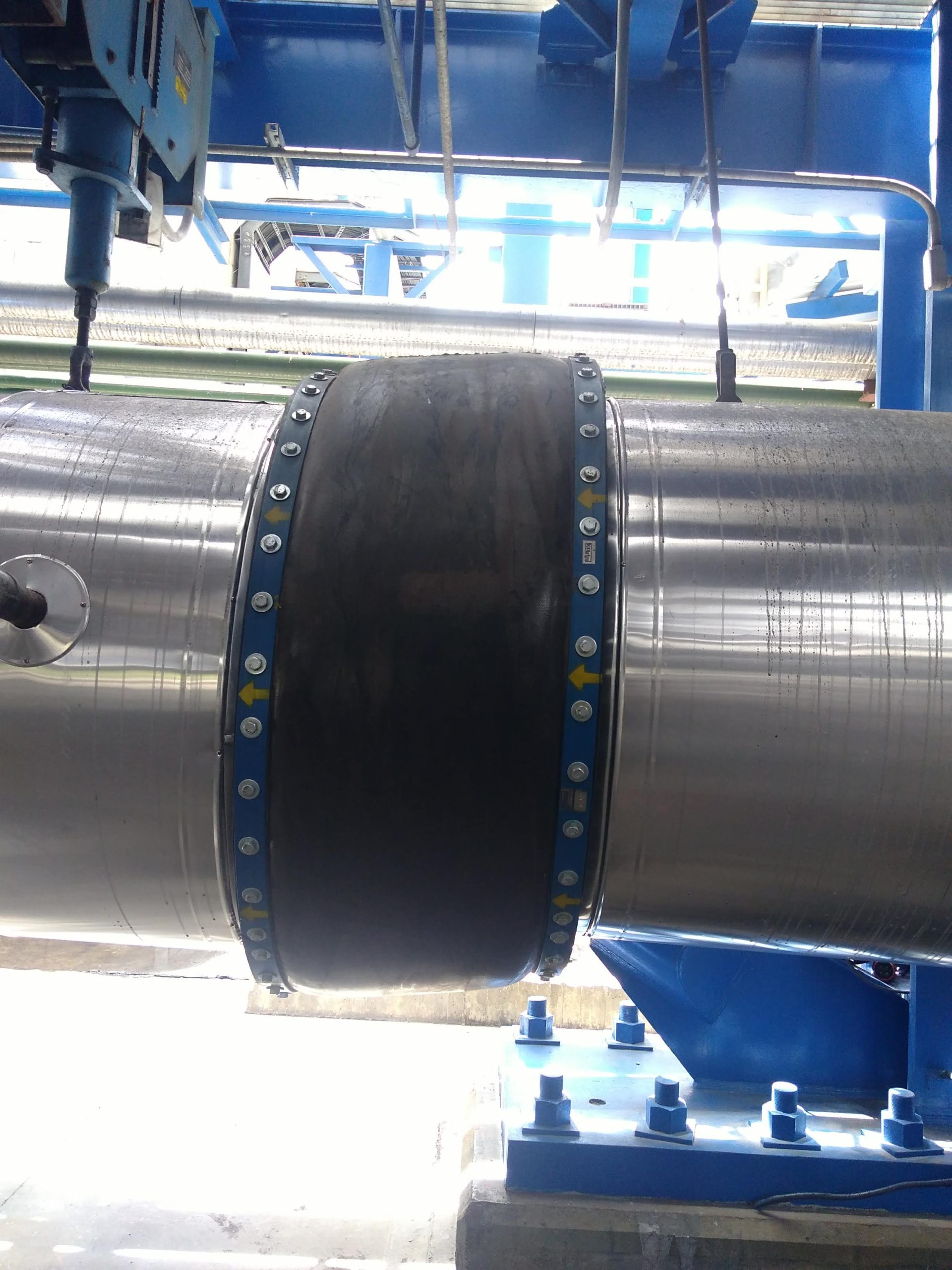
Thermal insulated design
Flexilatina from Colombia changed the design of the installed joints with a design that had thermal insulation and protected the fabric of the expansion joint; In this way, the passage of hot sand to the fabric was restricted, avoiding premature damage to it and guaranteeing a correct useful life of the fabric expansion joint, under the operating conditions mentioned by the client. Flexilatina from Colombia accompanied the installation and start-up of the hot air line, guaranteeing correct performance of the flexible solution.
Resistant materials for hot air ducts
These fabric expansion joints work with hot air and traces of sand at pressures less than 5 psi and temperatures that can reach 350°C. Therefore, for this design, resistant materials had to be used for these conditions. The most important thing for this type of joint is to design a chamber with thermal insulation high enough for the fabric to work at temperatures below 40°C, thus ensuring a longer useful life. The fabric used was Korema 4202 and the entire metal structure was made in ASTM A 516 GR70.
Flexilatina: Experience in fabric expansion joints
Since 1987, Flexilatina has supplied expansion joints for Colombia. These years of experience allow us to design and manufacture excellent flexible fabric solutions with an excellent quality-price ratio for chemical, petrochemical, cement, mining, etc. industries.

Design Features
Design parameters of fabric expansion joints for a chemical industry company in Colombia.
-
Metal structure in ASTM A516 GR 70.
-
Korema Fabric Ref. 4202.
From the inside out:
-
1 TSC® mineral fiber fabric with s/s reinforcement
-
1 C600 mineral fiber cloth
-
1 PTFE sheet
-
1 TSC® mineral fiber fabric with s/s reinforcement
-
50mm reinforced edge
-
HT3101 fiberglass
-
Permissible movements: Axial: +/-50 mm. Side: +/-20mm. Angle: +/-2°
Customer benefits
-
Complete documentation of the expansion joint design.
-
High quality inputs used in the manufacture of expansion joints.
-
Fabric expansion joint with identification plate for Flexilatina traceability, which facilitates replacement of the piece over the years.
-
Technical and engineering assistance.
-
Guarantee of an expansion joint with long useful life.
-
Periodic training for customers on products designed by the company.