


This type of accessory is used when the pressure of a fluid needs to be measured. Due to its physicochemical characteristics, it should not come into contact with the sensing element of a pressure gauge, pressure switch or a pressure transmitter.
Diaphragm seals protect pressure instruments from one or more damaging aspects of the process media.
When to use a stamp?
- The fluid to be measured is highly corrosive and the sensing elements of the instrument are not compatible with the fluid causing premature or adverse failure of the instrument. The seal diaphragm can be manufactured from a variety of materials and coatings that eliminate or dramatically reduce problems caused by corrosive media.
- The fluid is highly viscous and it is impossible for it to enter the sensing element of the manometer, switch or transmitter, or it enters slowly, which leads to very delayed response times of the instrument.
- The fluid tends to crystallize, especially during process stops. This event can block the pressure ports of the measuring instrument and prevent accurate pressure measurement.
- The fluid tends to polymerize. This can cause a blockage and does not allow free flow.
- The fluid is a mass or a sludge.
- The fluid is very hot. This may alter or deform the pressure gauge sensing element.
- The measurement point is located in a place that is difficult to access or is not visible. In this case a diaphragm seal with capillary line is required for remote measurements.
- Due to hygiene regulations. Most measuring instruments cannot meet 3A sanitary requirements due to inherent cracks in their design. Another issue is the ability of the measuring instrument to withstand the temperature requirements of steam cleaning used in many healthcare applications. In the case of a pressure gauge or a switch, these have cavities that are impossible to access for cleaning.
- If the system needs protection against overpressures, the seal with protection is the most appropriate.
What is important for a seal to function correctly?
The seal is basically a flexible membrane made of stainless steel or special alloys; It separates the fluid to be measured from the chamber where the sensing element of the manometer, switch or transmitter is located. On one side, the fluid hits the membrane, on the other side it is in contact with a chamber that must be filled with a well-selected liquid that allows pressure variations to be transmitted to the sensing element of the instrument. In conclusion, the pressure of the fluid is transmitted hydraulically to the manometer, switch or transmitter and this pressure generates a bending in the membrane that causes a change in the volume of the chamber above the diaphragm. The chamber between the diaphragm and the pressure measuring instrument must be filled by experts by completely removing the air inside the upper chamber and consequent unhindered entry of air pressure from the filling liquid to this chamber. This air extraction is carried out by applying vacuum to this chamber using a suction pump. To achieve this, specialized equipment is required to guarantee total vacuum in the chamber to be filled (upper chamber).
The filling process can never be carried out by overflow or gravity, these methods are incorrect and generate future errors in the reading because the interior of the filled chamber is left with air bubbles, which prevents the correct transmission of pressure by the filling fluid.
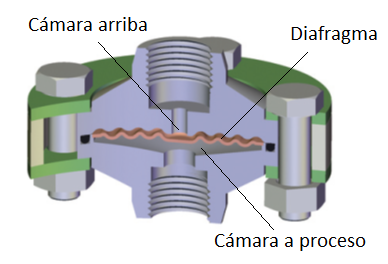
The displacement volume of the chemical seal compared to the volume of the measuring instrument (manometer or transmitter) is affected by other variables in practical applications. Volume changes of the system filling liquid caused by thermal expansion or compressibility must also be taken into account. To ensure full compatibility between the chemical seal, capillary, and pressure measuring instrument, the displacement volume of the chemical seal must always be greater than the sum of the maximum control volume for the instrument and the volume change of the system filling fluid.
The liquids used must be at a certain temperature, perfectly stirred. These liquids can be KN2 Silicone, KN92 USB grade mineral oil or KN3.2 Silicone for high temperature.
Diaphragm seals can be mounted directly to the measuring instrument and connected to the process in a threaded or flanged manner; It is also very common that they are connected to a capillary (up to 10 meters with correction) and the instrument is far from the pressure collection point.
The seals can be used with instruments that measure gauge, absolute or differential pressure.

Types of diaphragm separators
