


All pressure transducers and transmitters convert the pressure of a process line into an electrical signal.
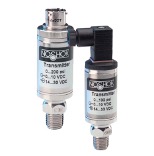
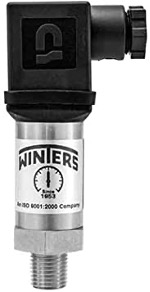
In general, pressure or differential pressure transmitters are vital elements in industrial facilities. Most of them can be found installed inside compressors, dryers, mounted on compressed air pipes, pressurized containers, accumulator tanks or line filters and in control systems such as PLCs.
Today, industrial plants handle compressed air, liquids, gases or steam. We are not only limited to seeing the pressure values in a certain line, but that value must be used in integrated control systems that perform work or certain actions with that value. To do this, this pressure measurement must be sent to them and it is done using an electrical signal.
Pressure transmitters are actually pressure sensors. Other names such as pressure transducers are also accepted, but care must be taken with this aspect because some manufacturers call equipment that sends signals in volts and not in mAmp a pressure transducer.
The most common electrical value in this type of equipment is 4 to 20 mAmp, using a two-wire cable like the one shown in the photograph.
Although the most used signal is in mAmp, you can also find applications that work with signals in volts. The most common are 1-5 volts or 0-10 volts with 3-wire cables, but 0-100 millivolts are also used with 4-wire cables.
In today’s industrial processes and controls, we witness technological advances with the advent of microprocessors and electronic components, Fieldbus technology, the Internet, etc., all to facilitate operations, guaranteeing the optimization and performance of the processes and operational safety. This advance today makes it possible for pressure transmitters, as well as those for other variables, to be designed to guarantee some performance in measurements that until then used only analog technology. The analog transmitters were designed with discrete components, susceptible to deviations due to temperature, environmental and process conditions, with constant adjustments through potentiometers and keys. With the advent of digital technology, simplicity of use became very easy.
Pressure transmitters are widely used in processes and applications with numerous functionalities and resources. The vast majority of industrial processes include pressure measurements, taking into account that pressure is a basic variable for measurement to control flow, level, density, etc.
The accuracy of a Pressure Transmitter
In recent decades, an enormous variety of equipment spread across the market through various applications. The accuracy of the transmitters is normally between 0.5% and 0.1%. Every pressure measurement system is made up of the primary element, which will be in direct or indirect contact with the process where the pressure changes occur, and the secondary element (the pressure transmitter), which will have the task of translating this change into measurable values for use in indication, monitoring and control.
The static performance or accuracy of a pressure transmitter depends on how well calibrated the instrument is and how long it can maintain its calibration. Keep in mind that accuracy is often confused with precision; Accuracy is associated with the proximity to the true value and precision is associated with the dispersion of values resulting from a series of measurements.
Calibration of a pressure transmitter includes zero and spam adjustment. Accuracy typically includes nonlinear effects of hysteresis and repeatability. Normally the accuracy is obtained in % of the calibrated spam.
Smart pressure transmitters


A smart transmitter mixes sensor technology with its electronics. It must provide the following characteristics:
- Digital output signal.
- Digital communication interface.
- Pressure compensation.
- Temperature compensation.
- Stability.
- Simple calibration.
- Re-rangeability with and without reference.
- Self-diagnosis.
- Easy installation.
- High reliability; They are very precise (from 0.5% to 0.01%).
- Low costs and short installation and maintenance times.
- Intrusion/penetration reduction (process).
- Saving installation space.
- Permission for updates to Foundation Fieldbus and Profibus PA technology, etc.
Flexilatina, continuing with its multi-brand strategy, offers the Colombian market different options from simple transmitters to smart transmitters. Our brands are Winters, Wika and Noshok; recognized and widely used brands in our country. We also have a pressure laboratory with ONAC 09-LAC-031 accreditation in calibration of pressure meters according to ISO/IEC 17025:2017, with a range from vacuum to 10,000 PSI. This means that the supply of our transmitters can be accompanied by a formal calibration certificate. Likewise, we are able to adjust and scale intelligent pressure transmitters that have the HART (Highway Addressable Remote Transducer) Protocol as a communication system.