


Like the best Hollywood movies, it is perhaps the most exciting moment of the film when that building finally explodes, with all the prop effects making the best shot, not letting go of any detail, the explosive wave, the destruction, the heat of the fire and an immense flame that rises beyond what was the building leave us stunned, with adrenaline pumping. thousand of what will follow. The truth is that fantasy is not very far from reality, in that case, the topic is no longer so exciting when they let people know that a loved one died or that a company was destroyed, as a result of the flames caused by the explosion in a production plant.
What is a dust collector and how does it work?
Basically a dust collector, also called a bag filter or bag filter, is a cylindrical or rectangular container capable of accumulating impurities from a productive area thanks to the suction caused by a fan. Inside said container there are filters also called sleeves or bags made of a flexible material, which capture the impurities and, in a certain time, through a programmed injection of air, the impurities fall by gravity towards the lower part of the collector. The product is removed through an airlock or rotary valve, it is hoped, in more compact and larger particles that can be reused.

Can there be explosion risks in dust collectors?
According to the annual report of incidents with combustible dusts from Dust Safety Science, dust collectors were involved in explosive incidents that caused considerable losses both in terms of location and human resources. When asked if there are risks with this equipment, the answer is a resounding yes. The graph below illustrates a little what was recorded with this type of equipment between the years 2018 and 2021 in the United States:

In short, dust collectors have a “magnet” for problems.
Only in recent weeks have sinister events been recorded around dust collectors, for example:
Case 1: Only on October 5, 2022 in the city of New York (USA) there was an accident associated with an aluminum dust collector at the Briggs Stratton company, a company dedicated to the manufacture of engines; The Daily Sentinel newspaper records the news. Although there were no injuries, there was considerable destruction around the dust collector. The matter remains under investigation. See the full news in the following link: https://romesentinel.com/stories/fire-outdoors-at-briggs-amp-stratton-in-sherrill,145268
Case 2: On October 6, 2022 in Illinois USA) there was an associated fire in the dust collector of the Quad printing services company, fortunately there were no injuries, the Daily News newspaper reports the complete news in the following link: https://www.effinghamdailynews.com/news/local_news/fire-at-quad-graphics-quickly-contained/article_c3b75212-45af-11ed-b090-2b7c5189c096.html
Case 3: On August 22, 2022 in Illinois (USA), there was another case around the metal dust collector at Westermeyer Industries, a family business dedicated to the manufacture of parts for industrial refrigeration, an employee who did not want to give the name indicated “that everything started in the dust collector and that in a matter of minutes the building was engulfed in flames”, the plant was completely destroyed, the local newspaper WLDS reported what happened: https://wlds.com/multiple-alarm-fire-destroys-majority-of-westermeyer-industries-complex-near-bluffs/
These are some recent cases from recent weeks, but what causes these teams to become a “time bomb”?
Although it is industrially used equipment, it is one of the most neglected and unknown.
How does a dust collector become neglected?
Careless because people do not do periodic maintenance that involves constant cleaning to avoid the prolonged accumulation of dust inside, add to that the bags or filters break, with this the equipment works inefficiently, the dust accumulates in parts where it does not have to be, such as contact with mechanical parts such as the suction fan, that really NEVER has to happen, and although most equipment has differential pressure sensors to know if a filter has broken, the “it’s not time to stop yet” leads to it being a real oversight. Another factor is the failure of the airlock, which in theory is responsible for removing the material collected in the hopper, leading the operator to intervene manually with striking tools (hammers, sticks, putting your hand in, etc.) generating static, leaving inadequate air inlets and what can we say about the solenoid valves, those responsible for cleaning the bags in a controlled manner, if these fail there is no automatic cleaning and the accumulation of dust is a fact. If the suction fan does not operate to the standards with which it was established, the suction or vacuum inside the collector is a fiasco.
As the plant is operating inefficiently, accumulation in the plant is a reality, the extractor hoods do not collect as they should, leading to dust in electrical gutters, lamps, hallways, offices, whether the dust collector is inside a building or not.
How can a dust collector be unknown?
Ignorance of what happens inside a collector is the most serious factor. NFPA 652 in Appendix A mentions the 5 basic components for a product to generate problems inside a dust collector.
a)A powder small enough to burn quickly and spread the flame.
b)A cloud suspended at a concentration greater than the minimum explosion concentration (MEC).
c)Confinement of the dust cloud by an enclosure or partial enclosure.
d)The atmosphere to support combustion.
e)An ignition source of energy or temperature suitable to ignite the dust cloud.
Then the NFPA 652 -2019 standard reflects the fire pentagon as a factor of what will happen if they find the components necessary for a fire, flash fire or an explosion.

Why is a powder explosive?
Because it is in its nature, because it is a combustible dust, that is, perhaps we study the behavior of the raw material of our production processes from an operational point of view, for example, that an agricultural product has a certain component of humidity, temperature, granulometry, etc. versus another, variables that influence the finished product to be what the client wants. For years, the different materials that are part of a production process have been the subject of study. Perhaps we never imagined that powdered milk, malt, rice, aluminum and many more, given certain characteristics of granulometry, suspension and confinement, are explosive, that is, they generate uncontrolled explosions, raising the pressure and temperature of the container in which they are, causing inadequate combustion, causing flames to emerge that can cause considerable damage, even DEATH.
The variables intrinsic to the product such as the MEC, the MIE, the MIT, the Pmax, the KST are key to determining the damage that a powder can cause inside a collector.
- The MEC (Minimum Explosive Concentration) is the minimum amount of dust concentration required in size per unit of volume (kg/m3) necessary to produce an explosive incident, any concentration lower or even higher than that measurement does not cause an explosion.
- MIE (Minimum Ignition Energy It is the minimum amount of energy in joules required to ignite a powder, in other words how sensitive a powder is to ignition by electrical or static spark.
- MIT (Minimum Ignition Temperature) It is the minimum amount of temperature that can cause ignition due to overheating of motors, bearings and any hot surface.
- Pmax: It is the maximum pressure (barg) that can cause an explosion, it is what makes it more dangerous, equipment such as dust collectors are not designed to reach that pressure, which is why they break violently generating great damage.
- KST: Dust deflagration rate (barg * m / second) that is, how quickly the dust housed in the collector generates the maximum pressure (Pmax), that speed is key to taking control action. If the action is not fast enough, the flame travels uncontrolled through ducts causing more dangerous explosions (secondary explosions) that can up to double the pressure Pmax and generate devastating effects.
There are specialized firms such as FIKE CORPORATION that offer dust analysis services to determine how dangerous it is. Perhaps the variables that make the difference in a powder are its Pmax and the KST. The NFPA determines in a category of four groups which product is more explosive than another.
The graph below reflects two examples of two different products to understand the difference between Pmax and KST.

From the previous graph it can be seen that product one with Pmax1 and Kst1 is more explosive and devastating than product two with Pmax2 and Kst2 when faced with the same container in cubic meters (m3), such as the dust collector, therefore, the response speed for mitigating or controlling the problem should be greater with product one than with product two.
With the arguments raised, we see the need to know what dust we are dealing with, perform periodic and adequate maintenance, properly clean the filters, guarantee the suitability of the filters or bags, make the corrective measures and prevent sparks from being generated in fans, helping to counteract the problem present in collectors and turning them into a time bomb. If the collector does NOT explode, we are the ones who let it explode. But is it enough?
Explosion mitigation, a viable and economical solution…
No matter how much we try to avoid a collapse of a dust collector, the conditions conducive to an explosion will always be present, no matter how clean the plant is, no matter how many sensors the collector has, no matter how efficient the suction fan is, even if the probabilities are remote, we cannot leave the possibility of an explosion to chance.
There are mechanical components called vent panels, which are designed to break once the explosive phenomenon occurs and which relieve the energy of the explosion (pressure and heat) in a controlled manner from the inside of the collector. The graph below reflects what actually happens:

If there was an explosion, the panels would not allow the collector to reach Pmax but rather Pred, that is, a “reduced pressure” below the design pressure of the collector, therefore the collector will never break apart, much less hurt anyone. What is sought is for the energy to relieve in a controlled manner where I want and not where the collector “wants”.
As can be seen in the following graphs, an uncontrolled explosion produces a fireball in a sphere or ellipse at 360 ° taking everything around it and a controlled explosion through one or more vent panels in a dust collector would look like this.
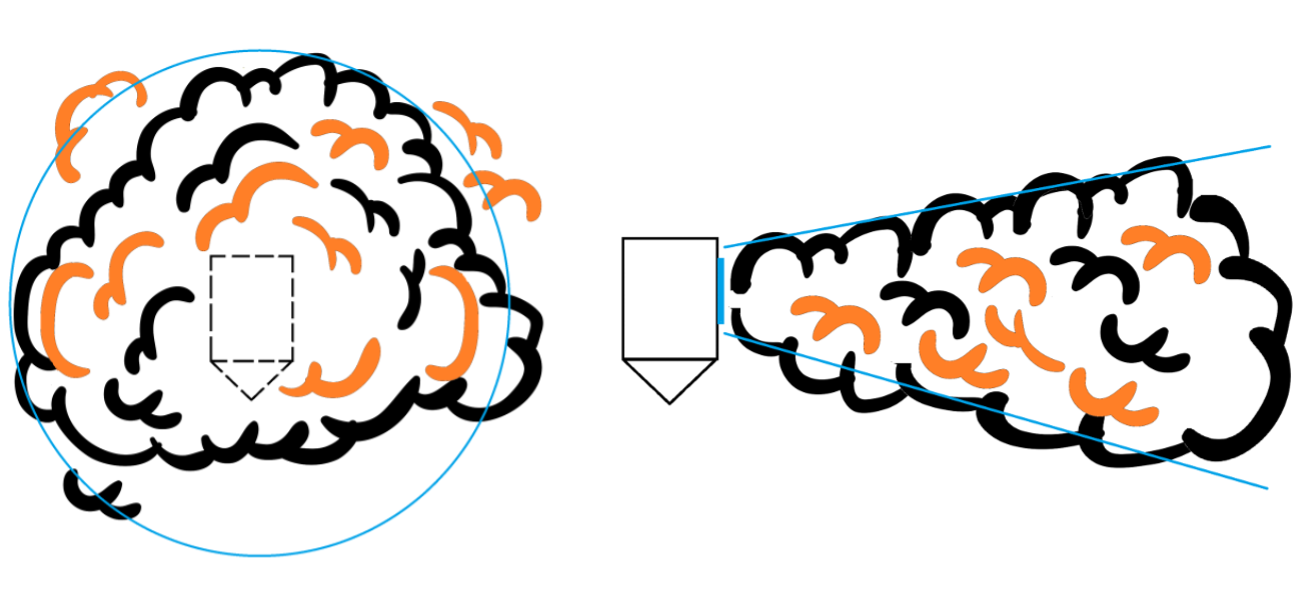
NFPA 68 (2018) in section 8.9 describes the associated variables and the resulting geometry of a controlled explosion, in summary we can say that the resulting distance depends on:

With this geometry you could say how much damage it can cause around the collector, its dependence is on how big the dust collector is, what product we handle and the number of vents or ventilation panels. With this result we can see how big a “fireball” is and how we can be attentive to it if it occurs.
FIKE CV vent panels a “pump-stopping” solution
FIKE vent panels offer a useful and effective solution to mitigate explosions within dust collectors as they are elements designed to withstand vacuum pressure, the environment in which the operation of this equipment takes place.
The panels are made from a 316L stainless steel sheet and can come in round and rectangular shapes. One or more of them is placed around the dust collector; They may come with break indicators, capable of giving an electrical signal showing the status if the panel has broken or not.
Among its characteristics are:
- 100% venting efficiency.
- Composite design without fragmentation.
- High mechanical integrity.
- Complies with NFPA 68.
As if it were the best solution for a “ticking time bomb”, venting honeycombs are undoubtedly a real “turn off” problem. Although the explosion can occur, with the CV and CV-s reference vent panels from FIKE the explosion occurs in a controlled manner without affecting the assets of the companies, much less the lives of their employees. Remember the Collector “DOES NOT EXPLODE” it is us who “LET IT EXPLODE” in an uncontrolled manner and that is what takes its toll on us sooner rather than later.
