


Equipment involved in the handling of combustible dusts such as dust collectors, mills, dryers, bucket elevators, among others, may be at high risk of suffering secondary explosions; explosions so violent that they cause damage to the equipment itself, to civil structures and even cause the death of employees.
“Secondary explosions” are explosions resulting from the spread of fire coming from another container through the pipe that interconnects the aforementioned equipment, where the fire moves increasing its speed and pressure. The pressure is many times above the pressure Pmax (maximum pressure of a primary explosion) therefore the damage is much greater.
There are elements such as isolation valves, capable of cutting off “the journey” of the flame or fire, thus preventing its spread.
The isolation valves have a system based on internal gates (flaps), capable of closing very quickly, preventing the fire or flame from spreading between the pipes that connect the equipment (see image) when an explosion has occurred.


Its simple design, free of electronic parts, is ideal for ensuring that the flame does not spread uncontrollably through the ducts. It is considered a “passive” element because it acts once the explosion occurs.
Depending on the temperature, the type of dust in the duct, the granulometry, the KST (explosivity index), the MIE (minimum ignition energy), among other variables, various types of isolation valves are used.
What are the benefits of passive explosion insulation?
During normal operation, passive isolation devices are held open by process flow or a spring retaining device and closed by the pressure wave of a deflagration; Therefore, no explosion detection and control system is required for activation.
The main benefits are:
- Often the most cost-effective explosion isolation solution.
- Does not require electronic detection systems.
- Installation does not usually require specially trained personnel.
- Maintenance requirements are minimal and easy to perform, significantly reducing downtime.
- Can be combined with active insulation systems.
Fike Coporation, world leader in manufacturing and marketing of elements for protection against explosive events with combustible dusts, incorporates into its solutions several references of isolation valves such as the DFI references (Dual Flap Isolation), ValVex, Ventex and Diverter.
Some important details of isolation valves are listed below:
DFI (Dual Flap Isolation) valve

The operation of the DFI valve is passive (flow activated), which means that no external power device is necessary to close the valve flaps upon deflagration. When process air flows during normal operation, the air pushes the valve flaps open, allowing air to pass from the process to protected equipment. If a deflagration occurs in the protected equipment, the explosion pressure created causes the process air to reverse the direction of flow, closing the flaps and thus preventing the flame front of the deflagration from advancing beyond the valve. The DFI valve is designed in accordance with the requirements of NFPA 69 and EN 16447.
Diameters: 4” -32”. Installation direction: vertical/horizontal.
Valvex® isolation valve
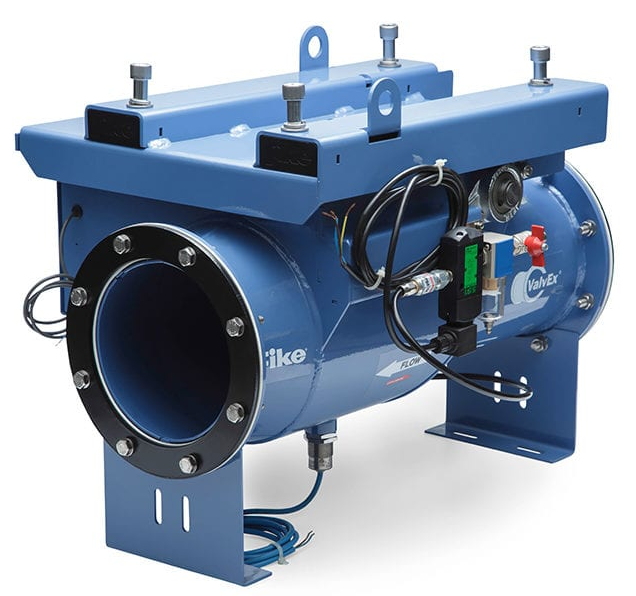
The Valvex® valve is composed of a steel-coated body and a high-integrity stainless steel clapper. The airflow will open the flap to allow for normal transport conditions. When an explosion occurs in process equipment, the flow will reverse and cause the flap to close over the gasket, stopping the pressure of the explosion and the spread of flames. Complies with standards with ATEX, NFPA69, INERIS 17ATEX0008X in accordance with EN16447.
Diameters: 4” – 16”. Installation direction: horizontal.
Ventex® isolation valve

The VENTEX® passive explosion isolation valve is a valve that prevents the spread of pressure and flame through interconnected pipes. The valve plug is closed by the pressure of the primary tank explosion, requiring no detection or control.
The valve can be used to stop the explosion in one direction or both. Complies with EN 15089 standard.
Diameters: 4” – 24”. Installation direction: vertical/horizontal.
Diverter isolation valve
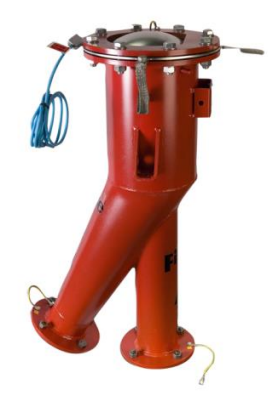
The blast diverter limits the effects of blast propagation in pipelines to a safe and acceptable level. A blast diverter combines blast venting with pipe routing to change flow direction 180º. The pressure wave, preceding the flame front, will open the vent panel installed at the top of the diverter, allowing the pressure to expand freely into the atmosphere. The flame front will follow the axial flow of the fuel outwards instead of rotating 180º, therefore the flame is disengaged or decoupled. Typically the diverter is installed between two volumes or in a pipe connected to a volume in which the explosion can originate. The diverter protects bi-directionally: with or against the process flow. Complies with EAC standards.
Diameters: 4” – 24”. Installation direction: vertical/horizontal.