


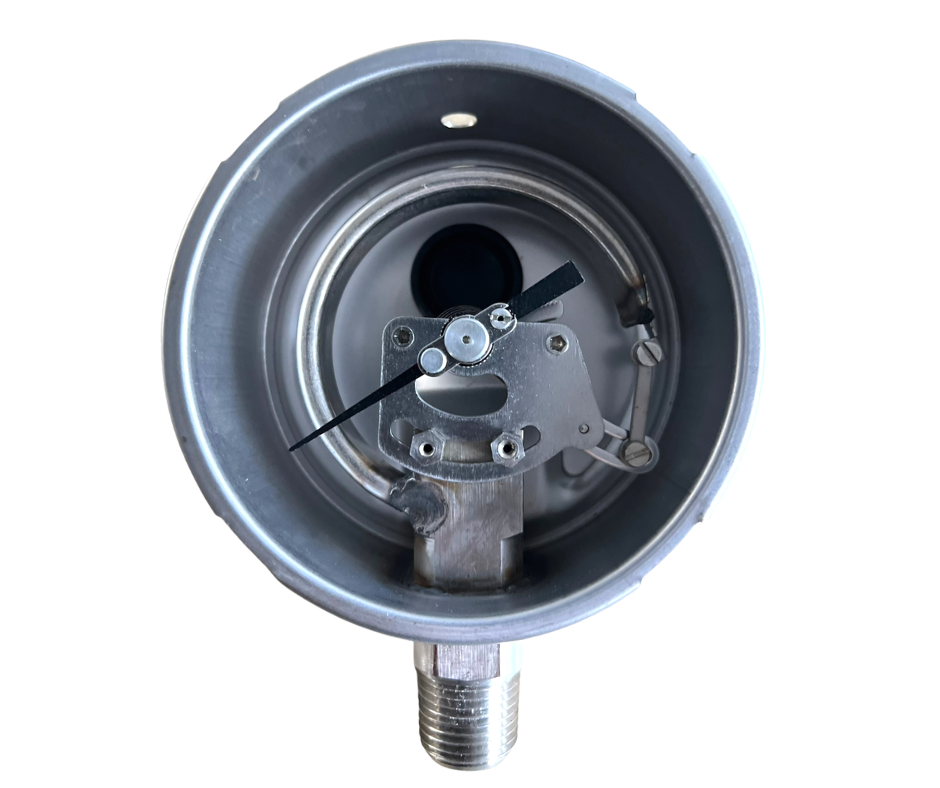
The most used manometers are the analog burdon type. They are optimal for measuring relative pressure and vacuum from 0.6 to 7,000 bar. Due to their mechanical technology they do not need auxiliary energy. This consists of a connection, an elastic element (burdon tube), followed or connected to an elongated link connected to the toothed segment (comb) which in turn moves the pinion that rotates the shaft where the needle is attached.
Bourdon springs consist of arc-curved tubes with an oval section. As pressure is applied to the inside of the tube, it tends to straighten and deform. The path of movement is transmitted to a mechanism and is the pressure measurement that is indicated by a needle. When the pressure is relieved or decreased, the burdon tube or elastic element tends to return to its initial position, in this way it measures the decrease in pressure in the same way as it measures its increase.
The movement is transmitted by a connection to a system of gears connected to a needle that will move proportionally to the pressure inside the burdon tube, on a graduated arc or dial that will mark the pressure. The springs curved at an angle of approximately 250° are suitable for pressures up to 60 bar. For higher pressures, Bourdon tubes with several superimposed windings of the same angular diameter (helical tubes) or with a spiral coil in one plane (spiral tubes) are used.