


The measurement of the variable temperature in industries is very important. Flexilatina, as a provider of solutions for measuring pressure and temperature, developed its own brand, this allows it to supply excellent quality thermometers at a very competitive price.
Our Galileo® thermometers are manufactured under international quality standards, ASME B40.3-2008 (rev 2013) and guarantee our customers long life, measurement accuracy and repeatability.
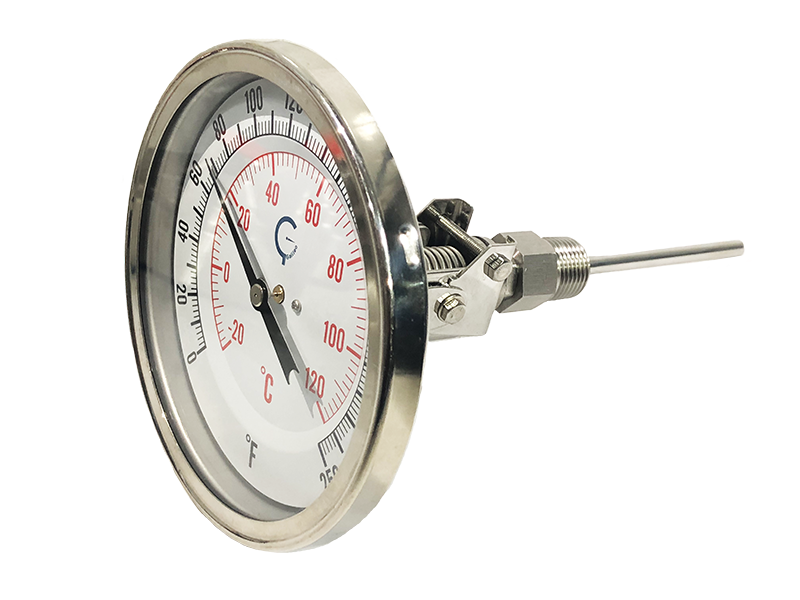
How does a bimetallic thermometer work?
The temperature sensing element is made of two lamellae of different alloys, one must have a high temperature coefficient and the other with a very low coefficient. These two sheets are joined by a mechanical process and rolled into a spiral. This bimetallic is encapsulated within a tube of reduced diameter, called a bulb or stem, normally made of 316 stainless steel. The operation is very simple, the bimetallic is welded to the end of the bulb, to the lower cover; The other end is connected directly to the indicator needle. When the temperature changes, the helical bimetallic element closes or opens and transmits the movement to the needle. The movement of the helical bimetal is produced by the change in temperature and as each sheet has a different temperature coefficient, one drags the other.
Components of a bimetallic thermometer
- Case: normally made of 304 or 316 stainless steel, it houses the face or dial, which is made of aluminum and on which the measurement scales are printed.
The diameters allowed by the standard are 1″, 1 ¾”, 2″, 3″ and 5″, the last two being the most common. The case always has a glass that protects the face and prevents the passage of external material. This glass must preferably be safety glass.
- Bulb or stem: Physically, it is a stainless tube, in which the sensor or bimetallic element is located internally. The bulb is the one that is inserted into the pipe or container in which you want to measure the temperature. The lengths allowed by the ASME standard are 2 ½”, 4”, 6”, 9”, 12”, 15”, 18” or 24”.
- Connection to the process: Thermometers have the connector, which is normally threaded, NPT or BSP, at the rear or at the bottom. It is very common to see a type of adjustable connector that allows you to connect the instrument to the process and move the pressure gauge case as needed and have several options for viewing the dial.
In conclusion, the thermometer can be requested with a vertical, rear or equalizable connection.
The most common process connections are ¼” and ½” NPT.
- Thermowell: It is an additional accessory, its function is to contain and protect the bulb and come into contact with the fluid to be measured, the manufacturing materials are many, from stainless steels to special alloys such as Hastelloy®, Inconel® or Monel®. Thermowells can be supplied threaded or flanged. The thermowell is optional.
Precision
The ASME B40.30 standard classifies them into grades A, B, C and D. Grade A is the most precise ± 1%, this precision varies throughout the spam, with the most precise point being the midpoint of the scale. Grade B ± 2%, Grade C ± 3% and Grade D ± 5%.

Scale ranges
For industrial applications, the standard defines the following:
-100 / 100 °F -50 / 50 °C
-40 / 160 °F 0 / 100 °C
0 / 250 °F 0 / 150 °C
50 / 400 °F 0 / 200 °C
50 / 550 °F 0 / 300 °C
150 / 750 °F 0 / 400 °C
200 / 1000 °F 100 / 550 °C
The ideal, today, is to supply thermometers on a dual scale °F / °C
Uses
Temperature is a very important variable in the industry, its proper use generates quality in the final product.
Bimetal thermometers are recommended for use in temperatures from -40 °F to 750 °F (-40 °C to 400 °). Temperatures outside this range must be handled with another type of instrument.
Installation

When the thermometer is going to measure a fluid in a pipe, we must install it as seen in the drawing; It is very important to know that when it is going to be installed in a horizontal pipe, the bulb must be immersed, at least up to the midpoint of the pipe, that is, if the pipe is 12″, it would be recommended that the bulb be 9″, this guarantees that the temperature will reach the entire bimetallic sensor, thus the response will be faster.
It is recommended to install the instrument in a place where it is not affected by mechanical vibration. Galileo thermometers comply with the IP 69 protection standard, which protects it from dust and water, not permanently.
Column thermometers

This type of thermometers are an alternative to measure temperature in some industries. In the past they were filled with mercury, today, some alcohols that are very sensitive to temperature are used.
Its operation consists of a cover, which has a printed temperature scale and a small column that is filled with a liquid that increases or decreases according to the temperature. The bulb is filled with the sensor liquid.
This type of column pressure gauges are connected to the process in three ways: vertical, rear or equalizable connection. It is very common to use thermowells to protect the bulb, which, because it is full of liquid, can contaminate the flow to be measured.
Its use is very frequent in cold processes, air conditioning and in general industrial applications that do not have aggressive external conditions.