


In bolted joints to ensure correct installation and adequate sealing static, the grade of the stud must be correctly selected. The ASTM A193 and ASTM A320 standards classify each of the grades of materials used for various industrial applications according to their mechanical and chemical properties, service environment, and temperature range. The difference between these two standards is that ASTM A193 works with high temperature services and ASTM A320 with low temperature services, the mechanical properties are similar between equivalent grades, for example B7=L7, B7M=L7M.

It is important to keep in mind that the deformations of the selected studs should not exceed the elastic zone of the materials, when passing to the plastic zone due to a very high stress, the deformation of the asparagus is permanent; The cross section of the stud is reduced, causing it to lose properties and even fracture or break, causing accidents, fluid leaks, premature plant shutdowns, equipment damage, etc.
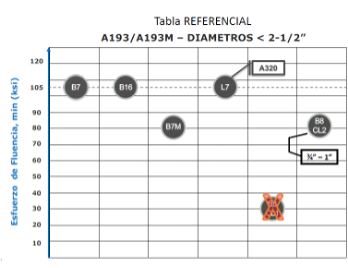
Depending on each grade of the studs, there is a yield limit, which is the maximum stress that can be reached without causing plastic deformation. As can be seen in the graph, grades B7, B16 and L7 have a higher limit than other grades, B8 class 1 has a very low yield limit (30 ksi) which makes its use in industrial applications very limited. On the other hand, grade B7 has better mechanical properties (creep, maximum stress and failure), but grade B7M has better anti-corrosion properties. The B7M grade is generally used in heat exchangers where the studs are in direct contact with the fluid.

To improve the properties of grade B7 against corrosion, it is recommended to use coatings to increase its useful life while maintaining its excellent mechanical properties.
Stud diameter, length, and material affect stiffness. As the diameter of the stud increases, creep decreases; The stud with a larger diameter and shorter length is more rigid, while the stud with a smaller diameter and longer length has greater flexibility. For example, a stud with a diameter of 4” x 12” is more rigid than a stud with a diameter of 2” x 12” in length.

To correctly select a stud it is always necessary to refer to the corresponding standard and code.
The temperature has effects on the mechanical properties of the asparagus; If the operating temperature of the studs is higher than the ambient temperature, the tensile strength and elasticity of the bolt will drop. Asparagus can fail with temperature, so it is important not to exceed the working limits specified by the standard; The yield and failure limits decrease as the diameter and temperature increase. A asparagus B7 operating at a temperature of 427°C has a lower yield point than an asparagus operating at an ambient temperature of 20°C.

For any request, do not hesitate to contact the technical department of Flexilatina de Colombia, which will best advise you on the correct selection of a stud to install in a flanged joint.